 Music is an integral part of dance and every culture has its own way of dancing and feeling music. These differences may be subtle or profound and can present challenges when learning a dance from another culture. For North Americans the differences between our own familiar music and dancing and Argentinean music and dancing are profound. This article will explore some of what this will mean to the beginning tango dancer.
The period from about 1935 until around 1952 is considered the golden age of tango music in Argentina. A succession of military dictatorships contributed to a hiatus in tango dancing from the late 1950s until the return to a democratic government in the early 1980s. When the dance halls reopened people danced to the same music they had in their youth from the Golden Age. The dance those people passed along to the next generation (and hence the dance that we learned in North America) is intimately connected with this music. You will hear recordings from earlier and later than this period, but you will always hear music from the Golden Age when you go out dancing. This will form the main body of music you will be dancing to as a new tango dancer; to learn to dance tango well then one must learn something of this music.
The core rhythmic structure of tango music is very different from most North American popular music. North American popular music owes something to blues, and jazz as they developed in the American South. This music is intimately connected to the musical traditions of West Africa, and as a result it has drums. Even if drums are not used in a particular recording, we know what they would sound like anyway. This is relevant to a dancer because there is a way we will move to feel music, even if we aren’t experienced as dancers. For North Americans this will often translate to a percussive bounce on the offbeat, and a swaying from side to side, even if we are walking which is illustrated in this video of Elvis from ‘Jailhouse Rock’.
Tango has African elements and it has been argued at great length how far these roots go. However, from the dancer’s point of view the drums are gone; even the memory of drums. This total lack of drums is one of the main things that make tango music feel so different, accounting for a lot of the difference in how tango is danced. Since there is no rhythmic bounce in tango, the music is felt in completely different movements.
Tango is danced as a walking dance, much more so than any North American couple dance form. The new dancer will be learning to feel the music in the movements of walking, which will be unfamiliar. It is a challenge to leave behind familiar movements – bouncing on the offbeat, swaying the hips, side to side swaying movement, and so on. Everything we would do naturally to feel like dancing has to be rewired. This is why it is important to know the music this dance comes from because this music has exactly the feeling we are looking for in our movements.
The strongest threads in tango music come from Italy and Spain. In fact the majority of the famous orchestra leaders have Italian last names and were generally first generation immigrants; for example Julio De Caro’s father was a violin player from Italy. Since this music is so intimately connected to Europe there is a lot of familiarity in song anatomy in terms of verse structure, number of measures per phrase in the music and so on. This means that overall the songs will not be so hard to understand, however our main work will be to feel dancing in our normal walking.
The beginning dancer will want to find music to practice to. When I was first learning tango in the mid 1990s it was hard to find any tango music at all and even harder to find anything from the Golden Age. We danced to whatever we could find which generally meant it said “Tango” in the title. The “Forever Tango” soundtrack was popular then, and it must be said at least it had real tango music but it was most definitely not good music for us to practice to. Today’s beginning dancer will have another problem; there is so much music available it will be hard to know where to begin.
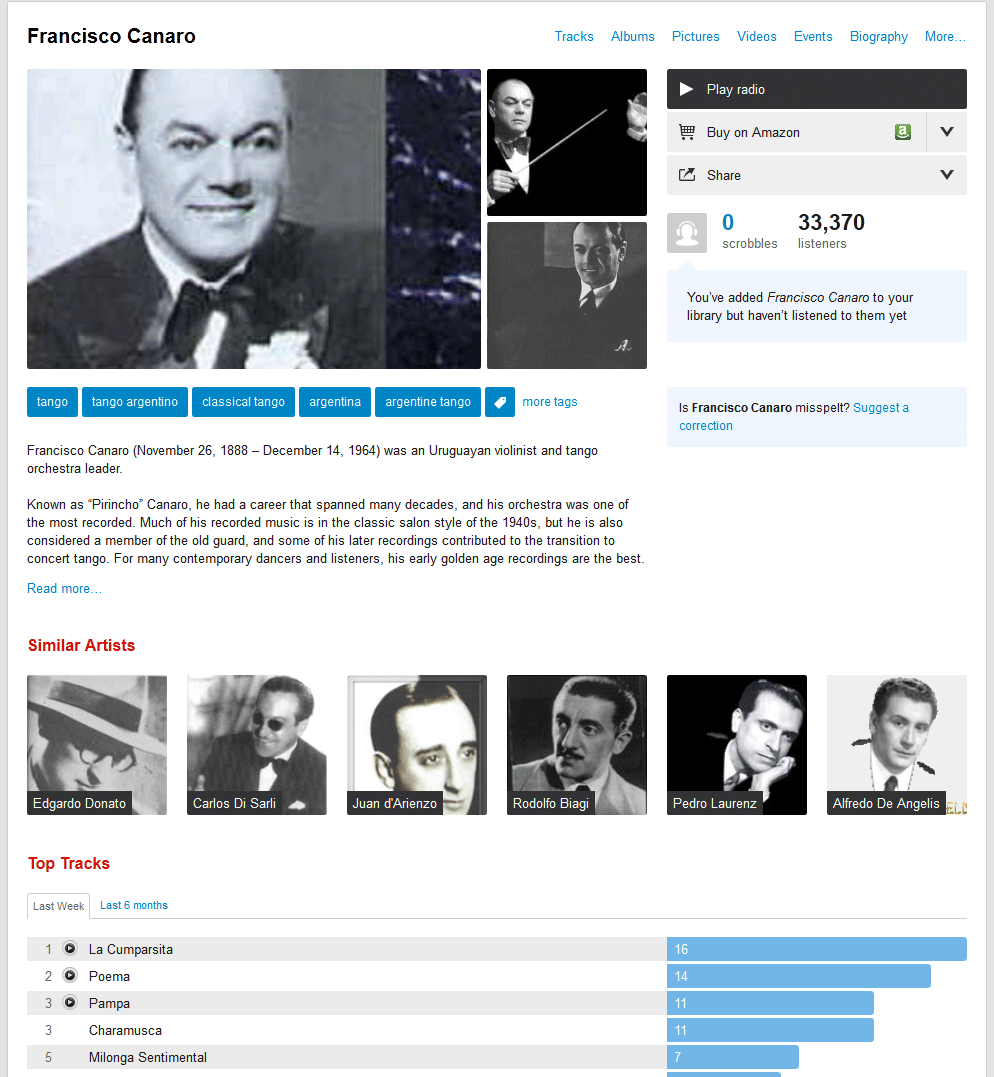
In my opinion the ideal music to practice the smooth walking characteristic of tango is from a little before the start of the Golden Age. I like music from the late 1920s and very early 1930s including Francisco Canaro, Orchesta Tipica Victor, and the sextet of Carlos Di Sarli. The music has a particularly regular walking beat, it is almost pedantic, which makes it great for practicing (though not so great for a dance party). I use this kind of music in my classes because it is so good for practicing this musical walking.
As you get comfortable with the foundations of walking you will want to move to more complex tango music. There will be a nice progression from the simpler music of the late 1920s to the much more complex music of the early 1950s.
If there is no beat there is no tango ~ Juan D’Arienzo
The best starting place to enter the Golden Age is with the orchestra of Juan D’Arienzo. The first thing you will notice about his sound is that it has a much more driving rhythm than the older music. Almost anything recorded in the Golden Age period will be danceable. His nickname was ‘The King of Rhythm’ (El Rey del Compas) and that speaks for itself. His music has a straight ahead rhythm, and it is always relatively easy to find the walking beat. There is more rhythmic variation used. Other orchestras with this kind of style are the orchestra of Edgardo Donato, especially in the period of the 1930s, and also the orchestra of Rudolfo Biagi. Biagi played piano in D’Arienzo’s orchestra when that signature sound was developed. Some credit Biagi with creating that sound. Eventually he left D’Arienzo’s orchestra to form his own, continuing to develop this kind of rhythmic style.
The orchestra of Osvaldo Fresedo is another to study. This music isn’t as driving rhythmically, favoring a more melodic style. Fresedo inspired Carlos Di Sarli, and some have said that without the Fresedo orchestra and style there wouldn’t have been a Di Sarli style.
As the Golden Age progressed vocalists became more important to the orchestra, and the musical focus is more on melody. The walking beat is still there to find but there is now the emotional range of the melody and the voice to feel as well. All of this feeling can be expressed in the walking, so as the music becomes more sophisticated so does the dance.
Through most of the Golden Age the rhythm of the orchestra is constant within a song. The music does ‘breathe’ though, the way the melody is played can give the illusion that the beat varies. In the 1950s Osvaldo Pugliese began to stretch this feeling and actually vary the tempo of the music. This is the last music that is truly dance music, Pugliese didn’t forget the dancers in this process, but the music demands more control from dancers. In this case dancers must be able to control the timing of the foot placement, and often this will be greatly slowed down. This will require very good control of balance.
After the Golden Age the music continued to evolve, and becomes concert music more than dance music. It takes a more experienced dancer to feel which of this music is good for dancing and which music is better for listening.
When you go out dancing you will also encounter two other musical styles, Valz and Milonga. The Valz is a three count music, waltz with a different spelling; you walk on the one, and have two interior beats to play with. Milonga is fundamentally a two count music, without a clearly marked offbeat. This makes walking to milonga music feel quite different from walking to tango music. These really deserve a separate article.